
Is your lawn a functional outdoor space or a muddy liability? For many homeowners, a heavy rain transforms the yard into a saturated mess that ruins turf and threatens the home's structural integrity. Finding effective drainage solutions Lancaster PA requires more than just digging a hole. You're likely dealing with the region's notoriously dense clay soil, which prevents natural percolation and leaves water pooling against your foundation walls.
We understand the frustration of watching your hardscape investments sink or your basement seep during a wet spring. You want a yard that stays dry and a foundation that remains secure regardless of the weather. This guide provides the blueprint to stop surface runoff and subsurface pooling for good. We'll explore how to identify your property's specific water sources, compare professional grading against French drain installations, and select a system tailored to our local topography. It's time to take control of your property and restore order to your landscape. By following these proven methods, you can protect your investment and enjoy a functional, dry yard all year long.
Understanding Yard Drainage Challenges in Lancaster County, PA
Landscape drainage is the engineered diversion of excess stormwater away from your home's foundation and outdoor living spaces. In Lancaster County, this isn't just about lawn aesthetics; it's about structural survival. Properties in Columbia and Mountville often face intense seasonal rainfall that overwhelms standard lawn grading. When water has nowhere to go, it builds up against foundation walls, creating immense hydrostatic pressure. This pressure eventually forces water through solid concrete, leading to basement seepage and cracked walls. Managing surface runoff quickly is the only way to prevent the kind of deep foundation damage that requires invasive, expensive repairs. Professional drainage solutions Lancaster PA focus on moving this water before it has the chance to saturate the earth near your home.
Lancaster Soil Composition and Water Retention
Local properties typically sit on Hagerstown silt-loam and dense clay. These materials have exceptionally low percolation rates, meaning they don't absorb water quickly. When water cannot move downward through the soil profile, it stays in the topsoil. This saturation causes chronic lawn diseases and root rot that destroy your turf. The problem scales during the winter months. Regional freeze-thaw cycles cause saturated ground to expand and contract violently. This movement shifts retaining walls and cracks concrete pads. A properly installed French drain or catch basin system mitigates this by providing a clear path for water to exit the property before it freezes and expands.
Common Symptoms of Property Drainage Failure
Identifying a failing system early saves your home from long-term damage. You should monitor your property for these specific warning signs:
- Persistent Standing Water: Puddles that remain visible 24 hours after a storm indicate total soil saturation and poor grading.
- Turf Degradation: Squishy grass, recurring mud tracks from pets, and the development of lawn moss suggest a lack of oxygen in the root zone.
- Structural Indicators: White, powdery efflorescence on exterior foundation walls and eroded topsoil in your garden beds are red flags.
If you notice these issues, your current grading or gutter system is likely failing to protect your investment. Proactive water management stops the cycle of erosion and protects your custom patio installation from settling or cracking. Implementing targeted drainage solutions Lancaster PA ensures your yard remains a functional asset rather than a muddy liability.
Comparing Core Exterior Drainage Solutions: Which System Fits Your Yard?
Selecting the correct drainage solutions Lancaster PA requires a clear understanding of how water moves across your specific lot. You shouldn't just guess where to dig. Instead, match the system to the symptom. Gravity-fed surface diversion handles massive volumes of rain, while perforated subsurface collection targets hidden groundwater. Integrating these systems creates a comprehensive shield for your property. Maintaining a watershed-friendly yard requires understanding how these different components interact with the local ecosystem to prevent erosion and runoff.
| Property Condition | Ideal Solution | Primary Benefit |
|---|---|---|
| Soggy turf and foundation moisture | French Drain | Intercepts subsurface water |
| Heavy hillside runoff | Surface Swale | Redirects high-volume flows |
| Driveway or patio pooling | Catch Basin | Point-source collection |
| Gutter overflow near walls | Downspout Extension | Moves roof water away |
French Drains and Subsurface Collection
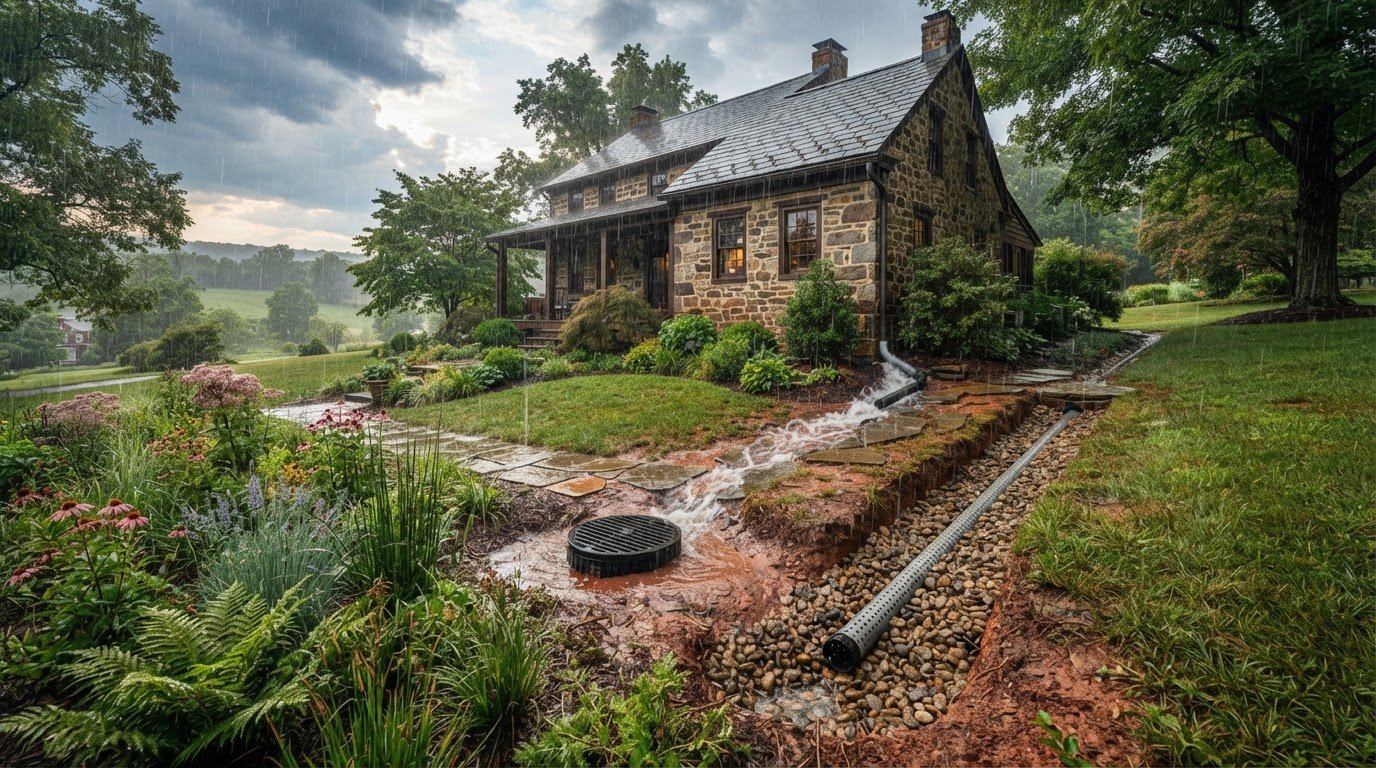
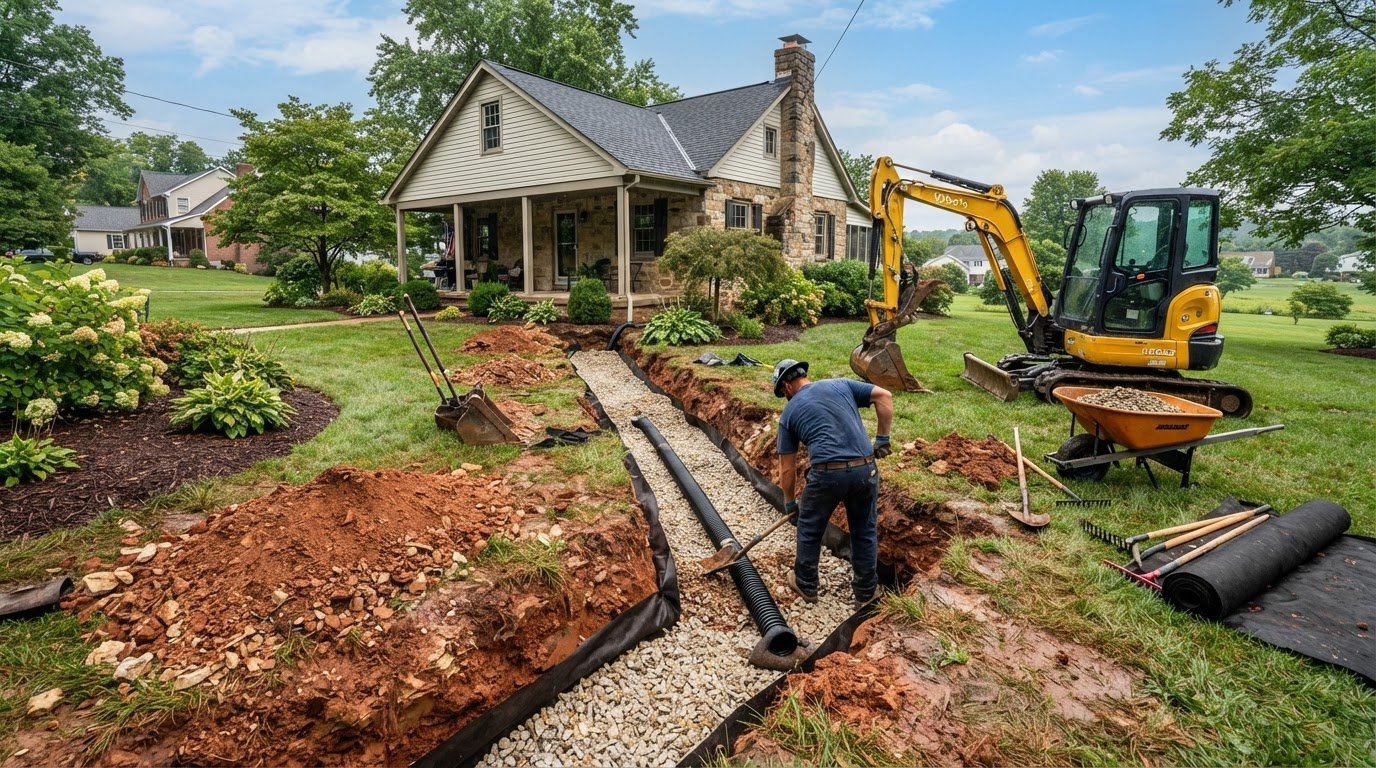
French drains act as a hidden gutter system for your soil. We install perforated piping inside a trench lined with non-woven geotextile fabric and filled with washed stone. This envelope allows groundwater to enter the pipe while keeping silt and sediment out. These trenches intercept groundwater before it reaches your foundation walls. You can choose a traditional gravel-to-surface finish for high-traffic areas or a hidden installation covered by turf for a seamless lawn appearance. Reliability depends entirely on the quality of the fabric and the slope of the trench.
Surface Swales and Decorative Dry Creek Beds
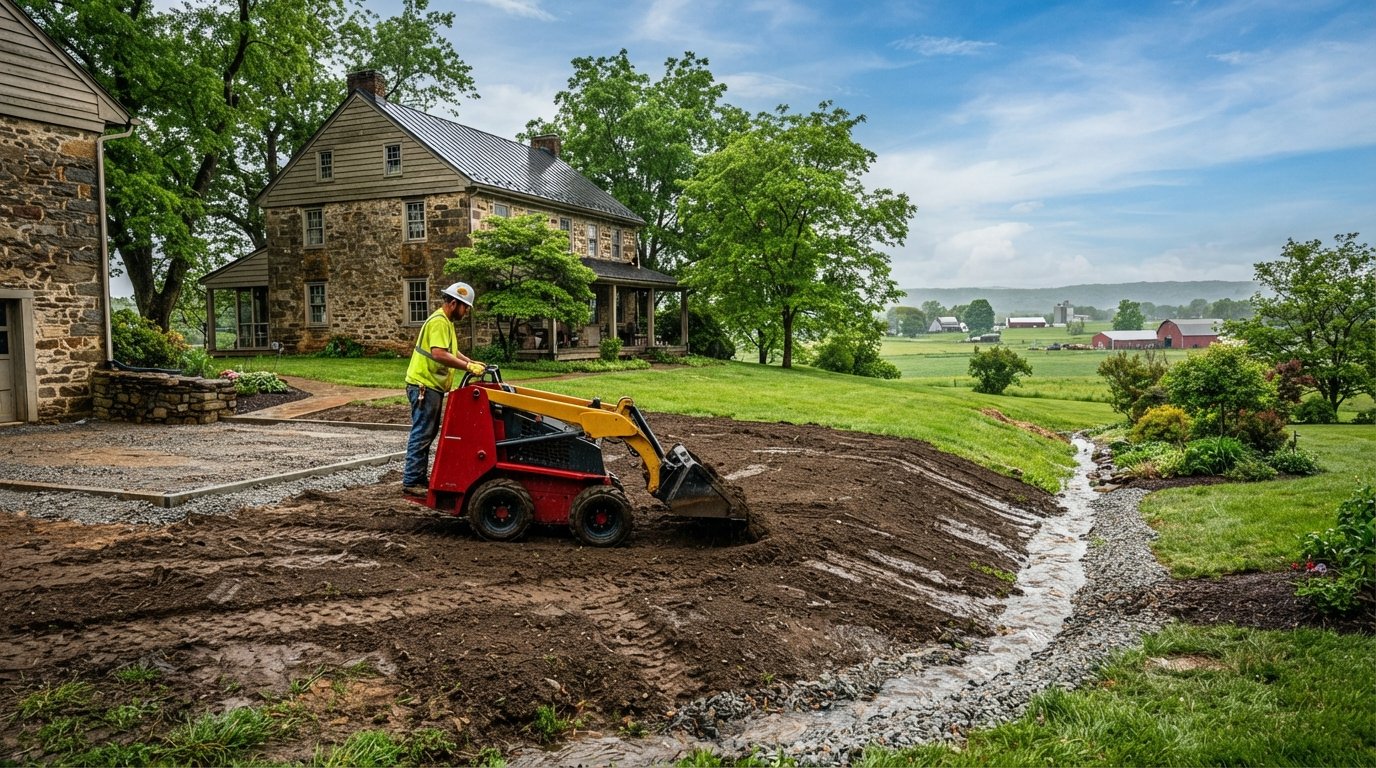
Broad, gently contoured swales are the workhorses of water transit. They channel massive overland runoff volumes toward safe discharge zones. If you want to combine aesthetic appeal with functionality, river rock dry creek beds are an excellent choice. These features mimic natural stream beds, providing a clear path for water during storms while acting as a landscape accent during dry spells. We carefully plan discharge zones to ensure you aren't simply redirecting water onto a neighbor's property, which is a common legal pitfall in suburban Lancaster.
Catch Basins and Buried Downspout Extensions
Catch basins provide point-source collection for concentrated pooling, often found in low driveway corners or at the base of a slope. We connect these basins to smooth PVC piping rather than corrugated flex pipe. Smooth walls prevent debris buildup and ensure maximum flow velocity. Buried downspout extensions integrate your roof drainage into this underground network. By using pop-up emitters at the daylight discharge point, we keep the system closed to pests while allowing water to exit safely away from your home. If you are unsure which system your property needs, reach out to our team for a professional site evaluation to identify the best drainage solutions Lancaster PA for your specific landscape.
The Role of Yard Grading and Hardscape Engineering in Water Management
Effective water management starts with the shape of the land itself. Positive grading, the practice of sloping soil away from structural foundations, forms your property's primary defense against water damage. We engineer a precise five-percent slope gradient for the first ten feet extending from your home. This means the ground drops six inches over a ten-foot distance. This geometric correction ensures that surface runoff moves rapidly away from foundation walls before it can pool and soak into the dense clay. On steep Lancaster hillsides, unmanaged water causes severe erosion and destabilizes the earth. We build heavy-duty retaining walls to terrace these slopes, halting soil movement while integrating internal channels to handle the water load.
Laser-Guided Grading and Slope Correction
We don't rely on visual guesswork to fix a sloped yard. Our team uses laser-guided optical levels to pinpoint exact high spots and map out natural runoff paths. This precision allows us to correct reverse grading, a dangerous condition where the yard slopes toward your home rather than away from it. By executing systematic rough and final grading phases, we reshape the topography to protect home foundation footers from water saturation. This structural correction is one of the most effective drainage solutions Lancaster PA homeowners can implement to prevent basement flooding.
Integrating Drainage Behind Retaining Walls
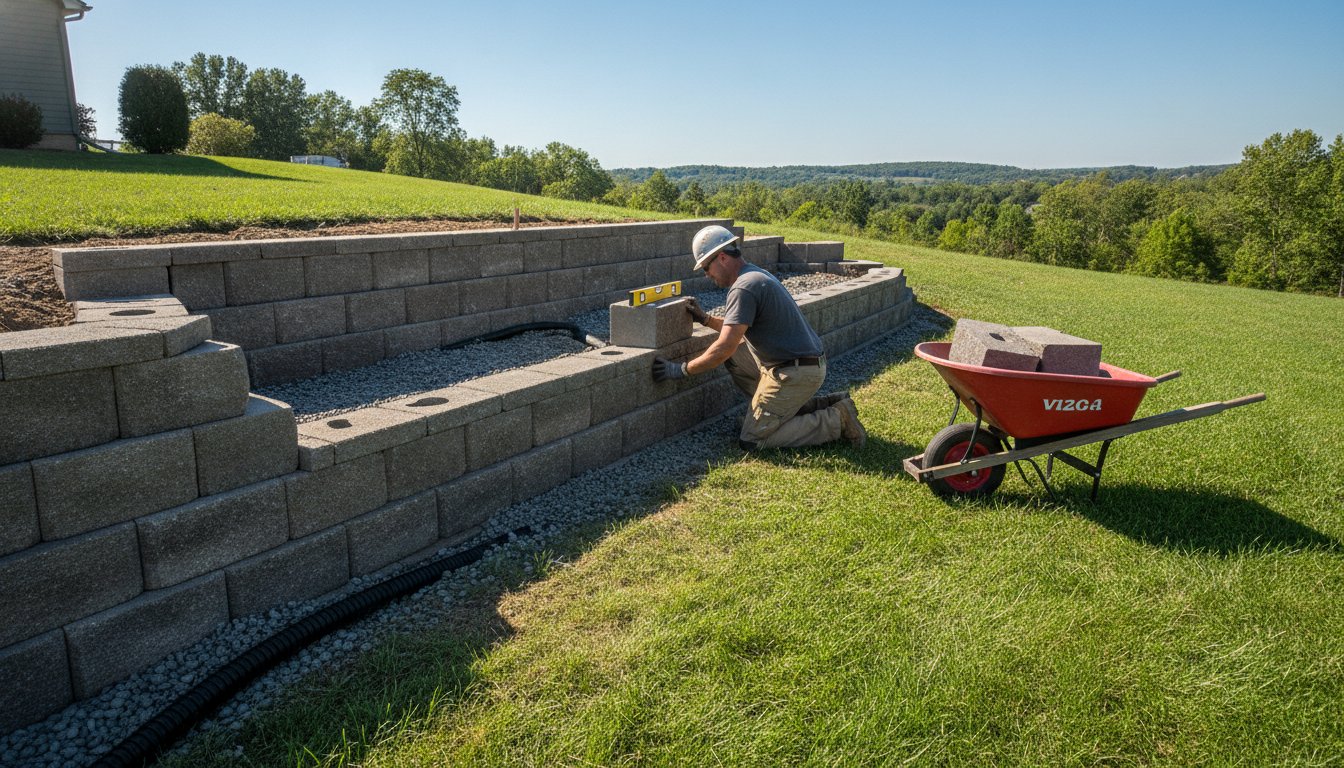
Water trapped behind a retaining wall creates immense hydrostatic pressure. This buildup is the primary reason walls lean, bow, or collapse entirely over time. To prevent failure, we pack the space directly behind the wall with clean aggregate backfill. We then place a perforated drain tile at the base of the wall to collect subsurface moisture. This pipe channels water safely out through engineered weep holes. For a deep dive into these structural requirements, review our guide on retaining wall drainage in Lancaster County to see how we guarantee structural longevity.
Protecting Custom Patios and Walkways
Modern hardscapes must work with water, not against it. When building concrete paver projects, we construct an open-graded stone base beneath the surface. This open stone reservoir temporarily holds water, allowing it to drain naturally rather than pooling on top. We combine this with permeable joint sand and install linear channel drains along patio edges to intercept heavy downpours. Investing in professional patio design and installation ensures your outdoor living space features the necessary pitch and drainage channels to remain stable for decades.
Step-by-Step Professional Drainage Design and Installation Process
Installing effective drainage solutions Lancaster PA requires a methodical, engineering-first approach. We don't just show up and start digging trenches. Our process begins with a comprehensive site consultation to assess your property's specific catchment area, elevation changes, and potential discharge routes. Before any heavy equipment touches your lawn, we coordinate with PA One Call to mark all underground utilities. This step ensures precision excavation planning and prevents dangerous utility strikes. Once we clear the layout, we carefully place professional-grade filter fabrics, aggregate bedding, and rigid pipes into the trenches. We run a final laser inspection across all pipe runs to verify correct water flow velocity before sealing the system.
Initial Site Evaluation and Watershed Mapping
We calculate your roof's total square footage and assess soil absorption rates to estimate the exact water volume your property handles during a heavy storm. This mathematical mapping allows us to size your pipes and basins accurately. Next, we locate natural downhill discharge routes that comply fully with Lancaster municipal codes regarding stormwater management. We also identify secondary factors that impact water movement, such as the root systems of large shade trees or concentrated asphalt runoff from your driveway.
Precision Trenching and System Assembly
Quality components determine the lifespan of your system. We use heavy-duty, rigid solid or perforated PVC piping rather than the cheap, flexible corrugated pipe often found at big-box stores. Smooth PVC walls prevent clogs and withstand shifting soil. We encase these pipes in clean, washed river gravel, which acts as a primary filter to prevent fine clay siltation from choking the system. Finally, we install accessible cleanout ports at critical junctions, allowing you to inspect and flush the system effortlessly in the future.
Backfilling and Complete Lawn Restoration
Excavation naturally disrupts your landscape, but we make sure that disruption is temporary. We use mechanical compaction equipment to tamp down the backfilled soil systematically, preventing the development of unsightly sunken trench lines over time. Once the trench is stable, we apply a fresh topsoil dressing and perform selective overseeding or install matching sod to blend the area back into your lawn. You can rely on our comprehensive property clean up services to restore your lawn's pristine appearance and ensure your outdoor living spaces look immaculate. If you're ready to fix your property's water issues with a permanent, engineered system, schedule your site evaluation with our team today.
Maintaining Your Yard Drainage System for Decades of Protection
A professional water management system is an investment in your home's structural future. To ensure that investment delivers long-term performance, you must establish a consistent seasonal maintenance routine. Lancaster properties face distinct environmental shifts, from heavy spring downpours to dense autumn leaf drops. Routine maintenance prevents debris from compromising your pipes and keeps water moving freely. Simple tasks like checking catch basin grates and clearing pop-up emitters keep the entire system running smoothly. You should also run a garden hose into your cleanout ports annually to flush out fine clay silt before it accumulates into a hard blockage. Partnering with a specialist ensures your exterior drainage solutions Lancaster PA remain fully operational year after year.
Seasonal Inspection and Clearing Protocols
Debris is the primary enemy of open drainage systems. You should adopt a strict seasonal checklist to protect your property's water routes:
- Autumn Leaf Removal: Clean all fallen leaves and organic debris from surface grates before heavy November rains wash them into the pipes.
- Sediment Trap Clearing: Scoop out accumulated silt from the bottom of your catch basins to prevent it from flowing into and choking subsurface lines.
- Spring Emitter Checks: Inspect pop-up discharge emitters immediately after the winter snow thaws to ensure the spring-loaded caps move freely.
Preventing Root Intrusion and Soil Compaction
Subsurface systems require physical protection from the surrounding landscape. Avoid planting deep-rooted shrubs or aggressive trees directly over your French drain lines, as roots easily infiltrate pipe perforations in search of water. You should also focus on maintaining a dense, healthy lawn above your underground systems. Thick turf acts as a natural pre-filter, trapping sediment on the surface before it can wash down into your aggregate stone beds. Utilizing professional lawn care and maintenance preserves your soil's structure and prevents the severe compaction that restricts natural water flow.
When to Call a Professional Drainage Specialist
Some drainage failures require specialized diagnostic equipment. If you notice persistent soggy spots directly over a buried line, or if water backs up out of your catch basins during minor showers, you likely have a crushed pipe or a complete silt blockage. Ground sinkholes forming along your underground lines are another major red flag, indicating that water is eroding the soil outside the pipe envelope. When these structural issues arise, you should schedule a comprehensive site evaluation with Snappy Landscaping to restore order and protect your property from foundation damage.
Take Control of Your Property's Water Management
Managing water on your property is a technical challenge that requires more than just a shovel and a bag of gravel. The heavy clay soils of Lancaster County demand a dual approach: precision surface grading to move runoff quickly and subsurface systems to intercept groundwater. By integrating these drainage solutions Lancaster PA into your custom masonry and landscaping, you create a permanent shield for your foundation and hardscape investments. A dry, stable yard isn't just about curb appeal; it's about protecting your home's structural integrity for decades to come.
Snappy Landscaping is a locally owned and operated team serving Lancaster, Mountville, and Columbia. We bring decades of combined experience to every project, delivering engineered solutions that combine precision grading with custom retaining walls and patios. We don't just fix symptoms; we manage outcomes. Stop letting standing water and foundation seepage dictate how you use your property. Schedule your Lancaster property drainage consultation today. Let's restore order to your landscape and give you the peace of mind you deserve.
Frequently Asked Questions
How do I know if my Lancaster property needs a French drain or simple yard re-grading?
You need a French drain if you have persistent subsurface moisture or foundation seepage, whereas re-grading fixes surface pooling by reshaping the lawn's pitch. In Lancaster's clay soil, grading often solves large-scale runoff issues, but subsurface water requires perforated piping. We use laser levels to determine if the issue is a lack of slope or a high water table. Combining these drainage solutions Lancaster PA ensures water stays away from your home's foundation footers.
Can a properly installed yard drainage system protect my home foundation from water damage?
Yes, a professionally engineered system prevents water from accumulating against foundation walls, which eliminates the hydrostatic pressure that causes cracks and seepage. By redirecting water before it saturates the soil near your basement, you protect the structural integrity of your home. This proactive mitigation is far more cost-effective than structural foundation repairs. Our systems combine precision grading and water redirection to safeguard your property's value and your family's safety.
Why do downspouts buried in corrugated plastic pipe fail faster in Lancaster County?
Corrugated plastic pipes fail because their interior ridges trap silt and organic debris, leading to inevitable clogs and root intrusion. In Lancaster's heavy soil, these flexible pipes often collapse or shift during regional freeze-thaw cycles. We exclusively use rigid PVC for underground downspout extensions. The smooth interior walls maintain high flow velocity and allow for easy flushing. Rigid piping provides a much higher crush rating, ensuring your system remains functional for decades.
Will installing an underground drainage system destroy my existing lawn and landscaping?
Modern installation techniques ensure your lawn returns to its original condition quickly through professional site restoration. We use specialized equipment to minimize soil disturbance and perform turnkey repairs once the pipes are buried. This includes mechanical compaction to prevent settling, followed by topsoil dressing and selective overseeding or sod replacement. Your landscape will look pristine within a few weeks, with the added benefit of being permanently dry and functional for your pets and family.
Where can water legally discharge from an exterior drainage system on Pennsylvania properties?
Pennsylvania law and local municipal codes generally prohibit discharging concentrated water directly onto a neighbor's property or into the public street without a permit. You must discharge water into natural swales, designated stormwater management areas, or on-site infiltration systems. We ensure every system complies with Pennsylvania Act 167 and local ordinances in townships like Penn and Ephrata. Proper discharge planning prevents legal disputes and ensures your system operates responsibly within your specific neighborhood.
What is the difference between a surface catch basin and an underground dry well?
A surface catch basin is a collection point designed to capture large volumes of runoff from driveways or low spots, while a dry well is an underground reservoir meant for water infiltration. Catch basins move water through pipes to a discharge point elsewhere. Dry wells hold the water and allow it to percolate slowly back into the ground. In dense Lancaster clay, dry wells must be sized correctly to prevent overflow during heavy seasonal storms.
How often do residential exterior drainage systems need professional maintenance or flushing?
You should perform a basic inspection of your system twice a year, specifically during the spring and fall. Clear leaves from grates and check pop-up emitters for free movement after the winter thaw. Professional flushing of subsurface pipes should occur every few years to remove fine silt buildup. Regular maintenance prevents small debris issues from turning into major blockages. Consistent care ensures your drainage solutions Lancaster PA continue to protect your foundation and hardscapes indefinitely.