
Failing Retaining Wall Signs: How to Spot Structural Trouble Before Collapse
That hairline crack in your backyard isn't just an aging mark; it's a structural warning. In Lancaster County, retaining walls don't usually fail in a sudden explosion of stone. Instead, they undergo a slow, silent process of collapse that starts long before the blocks hit the ground. You've likely looked at a leaning stone or a damp patch of soil and wondered if you can ignore it for one more season. It's stressful to weigh the possibility of a repair against the constant anxiety of a total wall failure.
We understand you want your property to remain stable and safe without overspending on unnecessary fixes. This guide identifies the critical failing retaining wall signs that demand immediate attention before they turn into a catastrophic property loss. You'll learn to distinguish between minor cosmetic wear and genuine structural threats. We'll also explain how our local clay soil and freeze-thaw cycles accelerate damage. This article provides a clear plan for professional assessment and outlines the steps to prevent further movement. By the end, you'll know exactly when to worry and how to protect your landscape from the heavy hydrostatic pressure that destroys improperly drained walls.
Understanding Retaining Wall Failure: More Than Just Aesthetics
A retaining wall isn't just a stack of stones; it's a functional machine designed to resist the immense lateral pressure of the earth. True structural failure occurs the moment a wall can no longer counteract the weight of the soil load behind it. Many homeowners view these structures as decorative boundaries, but they're actually critical engineering components. If the wall shifts, tilts, or cracks, it has failed its primary purpose. Identifying failing retaining wall signs early is the most effective way to protect your property value and avoid a total collapse.
In Lancaster County, our unique environment creates specific challenges for these structures. We look for "whispering" signs versus "screaming" signs. A whispering sign is a subtle change, like a slight gap between the wall and a walkway. A screaming sign is a visible bow or a block that has completely dislodged. Catching the whispers allows for targeted repairs, while ignoring them leads to the high costs of a full reconstruction. Retaining walls must be monitored regularly to ensure they remain plumb and stable.
The Role of Hydrostatic Pressure
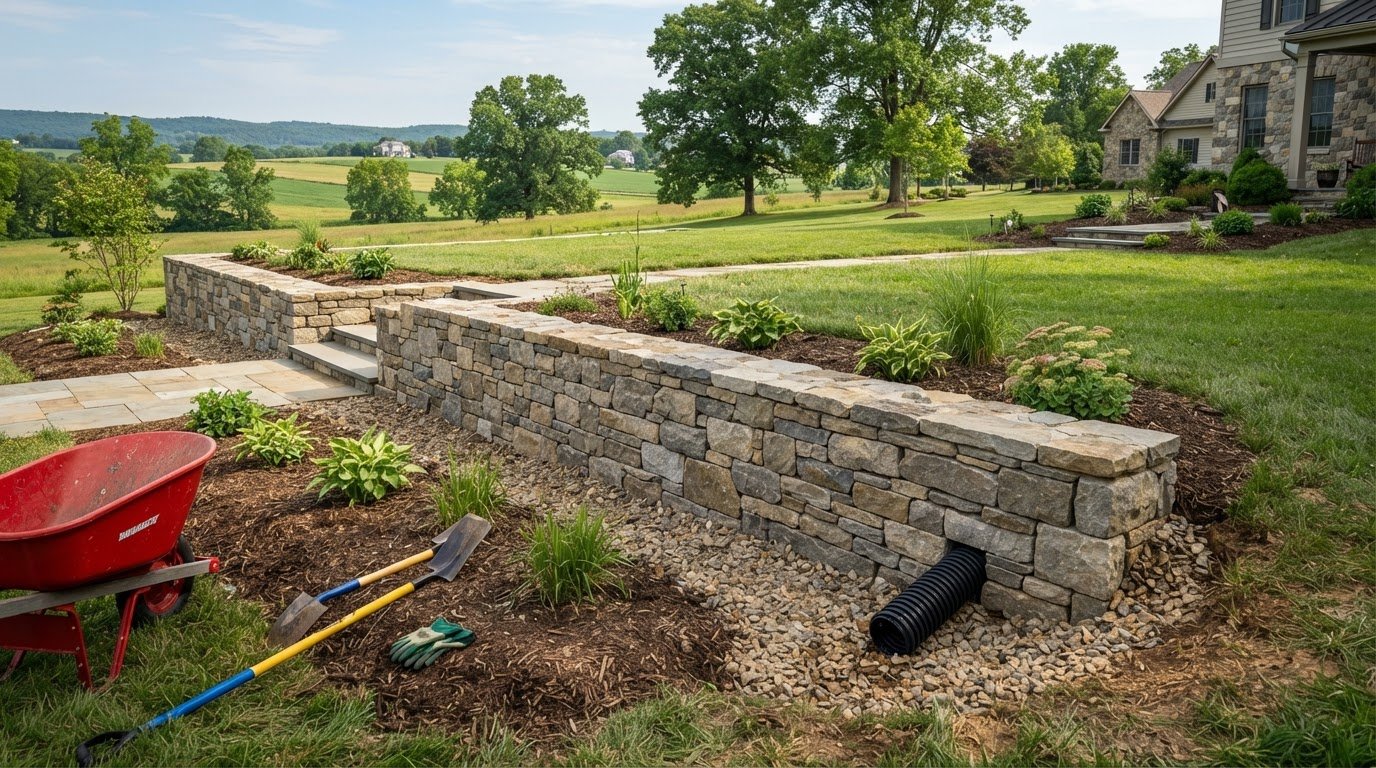
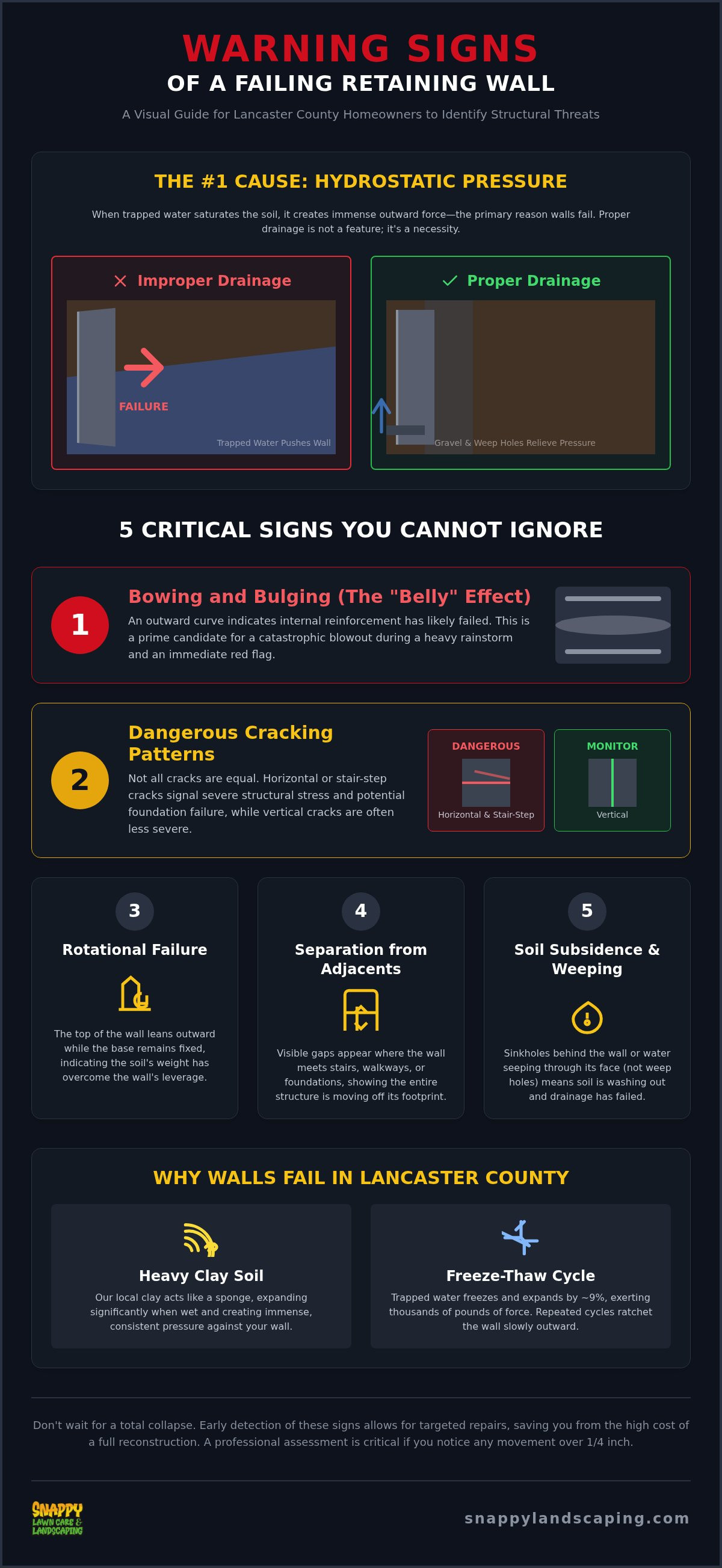
When heavy rains hit our local clay-heavy soil, the ground acts like a massive sponge. This creates the "balloon effect," where saturated soil expands and exerts outward force against the back of the wall. This weight can double or triple the load the structure was originally designed to hold. Hydrostatic pressure is the #1 cause of retaining wall failure. Without professional retaining wall construction techniques like gravel backfill and weep holes, this trapped water will eventually push the wall over.
Structural vs. Cosmetic Issues
It's vital to distinguish between surface-level wear and a structural breach. Homeowners often use the term "settling" as a way to ignore foundation failure, but real settling is uniform and occurs shortly after installation. If you notice any movement over 1/4 inch, it warrants an immediate professional inspection. While a hairline crack in a single block might be cosmetic, seeing multiple failing retaining wall signs together indicates the structure is losing its battle against the soil. Don't wait for a total collapse to address movement that has already begun.
5 Critical Failing Retaining Wall Signs You Cannot Ignore
Spotting trouble early requires a keen eye for subtle shifts in the landscape. While some aging is normal, certain failing retaining wall signs indicate that the structure is under extreme stress. Ignoring these warnings often leads to a total collapse that can damage nearby structures, patios, or pools. Watch for these five red flags on your property:
- Rotational Failure: This occurs when the top of the wall leans forward while the base stays put. It indicates that the weight of the soil has overcome the wall's leverage.
- Separation: Look for gaps where the wall meets adjacent walkways, stairs, or your home's foundation. If the wall is pulling away, it is physically moving off its footprint.
- Soil Subsidence: Noticeable sinkholes or "dips" in the turf directly behind the wall cap suggest that soil is washing out through the structure.
- Weeping: If water seeps through the face of the stone rather than exiting through dedicated drainage pipes, your internal system is likely clogged or nonexistent.
Bowing and Bulging (The "Belly" Effect)
A bulging wall, often called a "belly," is an immediate red flag. This sign usually indicates that the internal reinforcement, such as geogrid, has snapped or stretched beyond its limit. When the wall begins to bow, it loses its structural integrity and becomes a prime candidate for a catastrophic blowout during a heavy Lancaster County rainstorm. To detect this early, stand at one end of the wall and look down the line during the late afternoon. The uneven shadows created by the setting sun will highlight even a slight bulge before it becomes obvious from the front.
Cracking Patterns: Horizontal vs. Vertical
Not all cracks are created equal. Vertical cracks often result from minor settling, but horizontal cracks are incredibly dangerous. A horizontal crack suggests the wall is literally bending under the pressure of the earth. In block walls, you may also see "stair-step" cracks that follow the mortar lines. This pattern typically signals that the foundation or "footing" has failed or shifted. Never attempt to hide these issues by filling a structural crack with caulk or mortar. This simply traps more water and pressure behind the wall. Instead, seek professional guidance on retaining wall repair to address the root cause. If you notice these patterns, it is time to request a professional site assessment to determine your next steps.
Why Retaining Walls Fail in Lancaster County
Lancaster County landscapes face unique environmental stressors that accelerate structural decay. Our local soil in areas like Columbia and Mountville consists of heavy clay, which acts as a reservoir for moisture. This clay expands significantly when wet, creating the lateral force that leads to common failing retaining wall signs . In the Susquehanna Valley, heavy spring rains saturate the ground, turning the soil behind your wall into a heavy, semi-liquid mass that standard walls weren't built to withstand. Without the right engineering, this weight eventually wins the battle against your hardscaping.
The Impact of the Freeze-Thaw Cycle
Pennsylvania's winters are brutal on masonry and stone. When water trapped in the clay soil behind a wall freezes, it expands by approximately 9%. This expansion exerts thousands of pounds of pressure against the back of the structure. As temperatures fluctuate throughout January and February, this repeated cycle of freezing and thawing creates a "pumping" action. It slowly walks the blocks or stones out of their original alignment, often moving them just a few millimeters at a time. Walls built without a deep gravel base or proper backfill are the most vulnerable to this seasonal shifting, as they have no room to absorb the ground's movement.
Poor Drainage: The Silent Killer
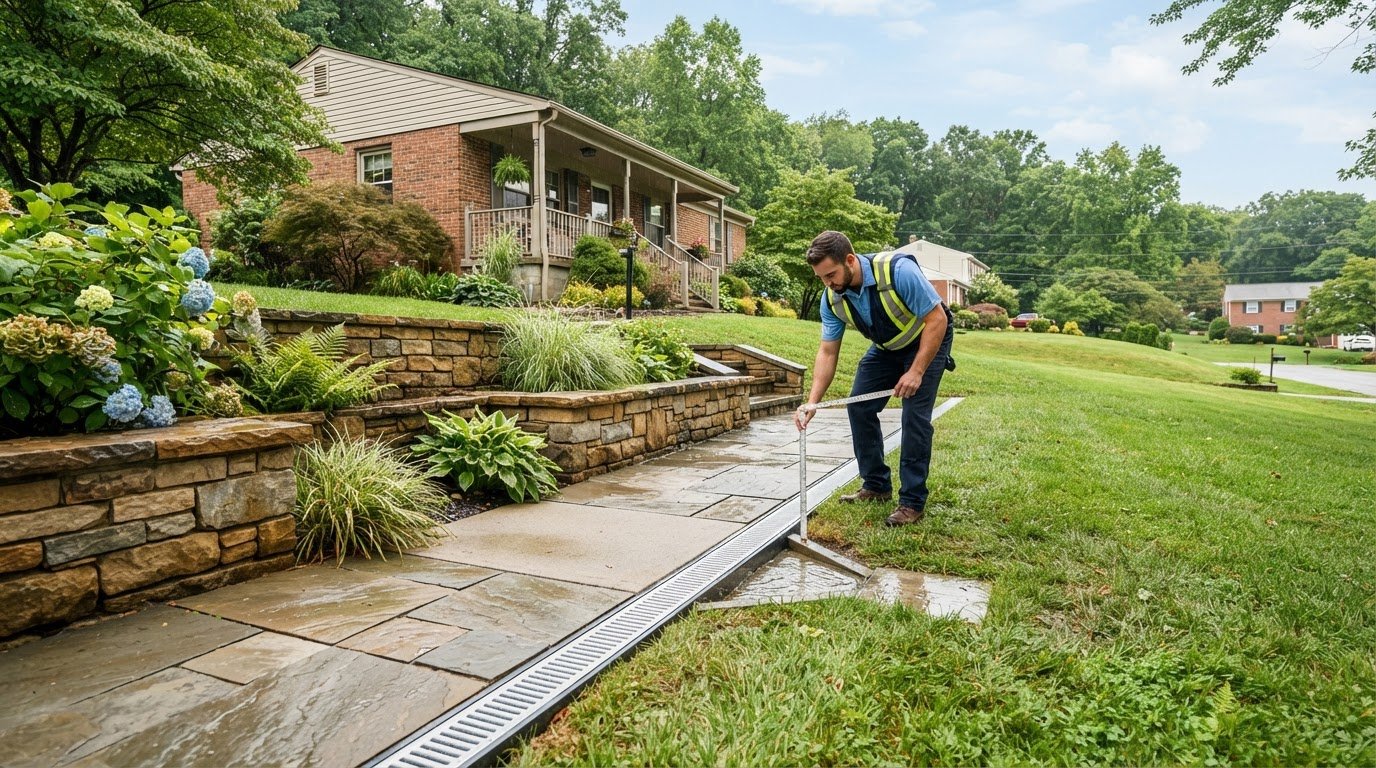
Effective drainage solutions are the only way to counteract Lancaster's wet climate. Without a dedicated 12-inch gravel chimney behind the structure, water has nowhere to go. It pools against the wall face, causing the soil to lose its load-bearing capacity and increasing the weight the wall must support. Warning signs of retaining wall failure often start with small drainage oversights, such as:
- Clogged or buried weep holes that no longer release water.
- Lack of a perforated drain pipe at the base of the footer.
- Surface water pooling at the top of the wall due to poor lawn pitch.
Furthermore, professional grading is essential for long-term stability. If your lawn slopes toward the wall rather than away from it, you're essentially funnelling every rainstorm into the structure's foundation. We frequently see DIY walls fail because they lack the necessary drainage pipe or the proper slope to move water safely past the stone. Proper water management is the difference between a wall that lasts 50 years and one that collapses in five. Orderly drainage isn't an optional add-on; it's the foundation of a wall's survival.
Myth-Busting: Common Misconceptions About Wall Failure
Homeowners often try to rationalize the structural issues they see in their backyard. It's a natural response to the anxiety of potential repair costs. However, many common assumptions about masonry and soil mechanics are physically impossible. Believing these myths can lead to property damage that far exceeds the cost of an early intervention. When you spot failing retaining wall signs , it's critical to separate wishful thinking from engineering reality.
- Myth: "The wall has been leaning for years, so it's stable now." Reality: Soil is a dynamic load. Just because a wall hasn't collapsed yet doesn't mean it has reached equilibrium. Gravity is constant, and every rainstorm adds new pressure.
- Myth: "Planting large trees behind the wall will help hold the soil." Reality: This is one of the most dangerous misconceptions. Tree roots grow and expand, acting like hydraulic jacks that push blocks out of alignment. Additionally, the weight of a mature tree adds a "surcharge load" that the wall likely wasn't designed to support.
- Myth: "Retaining walls are maintenance-free." Reality: You must regularly clear debris from weep holes and ensure that surface grading hasn't shifted. Neglect is a primary driver of premature failure.
The Danger of the "Wait and See" Approach
Gravity doesn't take days off. A compromised structure is in a state of slow-motion collapse, and the rate of decay usually accelerates as the lean increases. Waiting to act is a gamble with your budget. A repair that costs $2,000 today often turns into a $20,000 total replacement once the wall actually hits the ground. Damage rarely stays confined to the wall itself; it often takes out adjacent fences, patios, or expensive landscaping. A leaning wall is not a settled wall; it is a wall in progress toward collapse.
Why DIY Patches Make Things Worse
Applying mortar or caulk to a structural crack is like putting a piece of tape over a leaking dam. It doesn't solve the pressure problem; it hides it. Sealing these gaps actually traps water behind the face of the stone, which increases hydrostatic pressure and speeds up the "belly" effect we discussed earlier. Similarly, pouring a concrete "lip" at the base to stop rotation rarely works because the failure is happening at the foundation level. You need a retaining wall inspection to identify if the geogrid has failed or if the footer was installed too shallow for Lancaster's freeze-thaw cycles. Before you spend money on temporary patches that will fail, contact us for a professional structural assessment to get a long-term solution.
Repair vs. Replace: Taking Action on a Failing Wall
Deciding whether to salvage a wall or tear it down is a high-stakes calculation. For many homeowners, the "point of no return" is hard to identify without technical expertise. A wall that has reached its limit poses more than just a landscape headache; it's a liability. Catastrophic failure can lead to severe property loss, personal injury, or even lawsuits if the collapse affects a neighbor's lot. Professional hardscaping contractors provide the structural assessment needed to determine if the internal components are still viable.
Sometimes, the failing retaining wall signs you see are symptoms of a fixable drainage issue. If the wall is structurally sound but suffering from water pressure, retrofitting a new drainage system can stop the movement in its tracks. This proactive step saves the existing stone while removing the hydrostatic force that causes bowing. However, if the foundation has shifted significantly, no amount of new gravel will restore its integrity. We evaluate the cost of stabilization versus the longevity of a new build to give you a pragmatic path forward.
When is Repair an Option?
Repair is often feasible if the wall shows minor tilting of less than 5 degrees and the geogrid reinforcement remains intact. We look for simple drainage clogs that can be cleared or tie-backs that can be added to stabilize the face. It's also vital to check the base for scouring or erosion. If heavy rains have washed soil away from the bottom blocks but the footer is still level, we can often reinforce the base to prevent further sliding. Pinning or adding tie-backs can provide the necessary tension to keep a slightly leaning wall from progressing toward a total blowout.
Signs Total Replacement is Necessary
Total replacement becomes mandatory when you encounter "Total Base Failure." This is where the bottom row of blocks kicks outward, indicating the entire foundation has lost its grip. In older concrete structures, look for spalling or crumbling materials. This chemical breakdown of the concrete cannot be reversed with surface patches. If the wall has multiple failing retaining wall signs like deep horizontal cracks and a "belly" bulge exceeding several inches, the structural cage has likely snapped. At this stage, demolition and reconstruction are the only safe paths forward. Don't risk a sudden collapse during the next storm. Contact Snappy Landscaping for a professional retaining wall evaluation to secure your property today.
Secure Your Property with a Professional Structural Assessment
Ignoring the early warnings of a shifting landscape only leads to higher costs and greater risks. By learning to identify failing retaining wall signs , you've taken the first step toward protecting your home from the heavy clay soils and intense freeze-thaw cycles of Lancaster County. Remember that structural integrity depends on more than just appearance; it requires expert water management and professional-grade construction standards. Whether your wall needs a strategic drainage retrofit or a complete reconstruction, acting now prevents the sudden property loss that follows a total collapse.
Snappy Landscaping provides pragmatic, no-nonsense property solutions to homeowners in Lancaster, Columbia, and Mountville. We specialize in PA-specific drainage and erosion control, ensuring your hardscaping stands up to the Susquehanna Valley's toughest weather. Don't leave your safety to chance or rely on temporary DIY patches that trap moisture and increase pressure. Our team delivers the reliable expert guidance you need to restore order to your outdoor space. Get a Professional Retaining Wall Inspection from Snappy Landscaping today and gain the peace of mind that comes with a stable, secure foundation.
Frequently Asked Questions
Is a small crack in my retaining wall always a sign of failure?
Not always, but it requires immediate monitoring. Distinguish between cosmetic hairline cracks and structural breaches. A single small crack in one block might be minor. However, multiple cracks or gaps wider than 1/4 inch suggest the wall is under extreme stress. These are early failing retaining wall signs that indicate the structure is struggling to manage the lateral pressure of the saturated soil behind it.
How much leaning is considered "normal" for an older retaining wall?
No amount of leaning is considered normal for a structural wall. While older walls might shift slightly over decades, any lean exceeding 5 degrees is a major red flag. If the top of the wall is visibly out of plumb with the base, the structure has already begun to fail. This movement indicates that gravity and soil pressure have overcome the wall's original design and foundation.
Can heavy rain cause a retaining wall to collapse suddenly?
Yes, heavy rain is the primary trigger for sudden wall collapse. Saturated soil creates hydrostatic pressure, which can double or triple the weight the wall must withstand. In Lancaster County, spring rainstorms turn clay soil into a heavy, liquid mass that pushes against the structure. If your drainage system is clogged or nonexistent, this pressure builds until the wall reaches a breaking point, resulting in a sudden blowout.
Will insurance cover the cost of a failing retaining wall?
Insurance coverage depends entirely on your policy and the specific cause of damage. Most standard homeowners' policies don't cover walls that fail due to aging, poor maintenance, or natural earth movement. However, if a sudden event like a vehicle impact or a fallen tree causes the damage, you might have a valid claim. Always consult your insurance agent to verify your coverage before assuming that structural repairs are included.
How long do retaining walls typically last in Pennsylvania?
A professionally installed wall should last between 50 and 100 years. However, Pennsylvania's freeze-thaw cycles and heavy clay soils shorten this lifespan if the wall wasn't built correctly. Walls without proper drainage or those built with inferior materials often show failing retaining wall signs within 10 to 15 years. Proper construction with a deep gravel base and professional grading is the only way to reach a 50-year milestone in our climate.
Can I fix a bulging retaining wall myself by removing some soil?
Removing soil is a temporary measure that doesn't fix the underlying structural failure. A bulge means the internal reinforcement, like geogrid, has already stretched or snapped. Removing soil might reduce pressure for a few days, but it won't restore the wall's integrity. DIY repairs in high-pressure soil environments are dangerous and often lead to total collapse. You need a professional assessment to determine if the wall is worth saving.
What is the most common reason retaining walls fail in Lancaster County?
Poor drainage is the most common reason walls fail in our local area. Lancaster County's heavy clay soil retains moisture, which increases the hydrostatic pressure against the back of the wall. When this moisture freezes during PA winters, it expands and pushes the structure out of alignment. Without a 12-inch gravel chimney and functioning weep holes, even a heavy stone wall will eventually succumb to the pressure of saturated earth.
How do I know if my retaining wall has proper drainage?
Check for active weep holes and a gravel backfill layer. During a heavy rainstorm, you should see water exiting through dedicated drainage pipes. If water is instead seeping through the face of the stone or pooling at the base, your drainage is inadequate. Another sign of failure is soil subsidence or sinkholes forming directly behind the wall cap, which indicates that water is washing soil out through the structure.